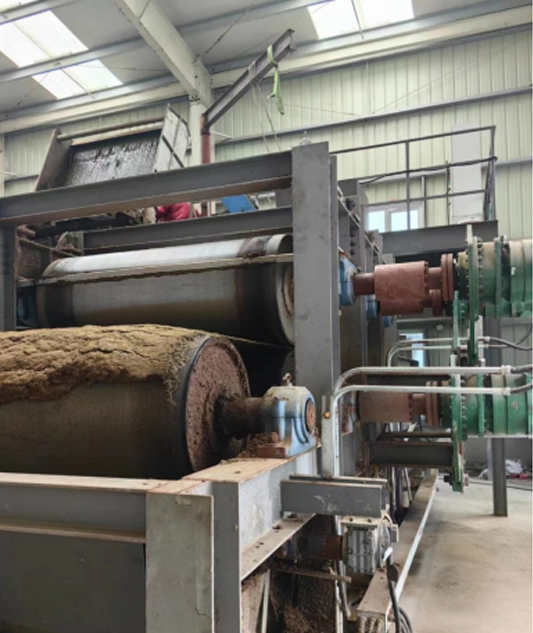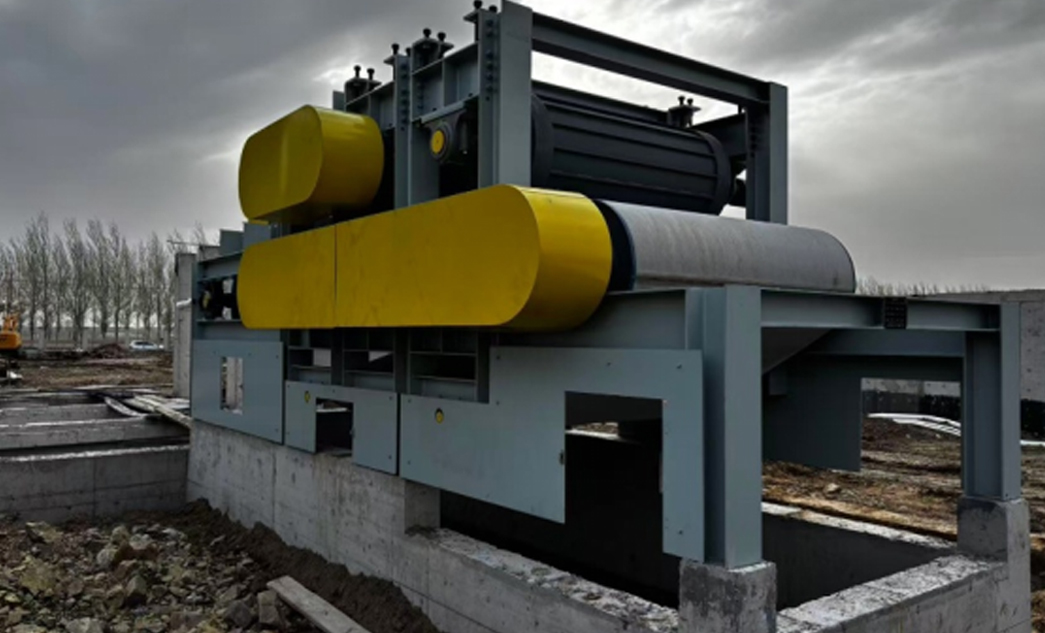
Drum filter press
Applicable Raw Materials
Viscous materials such as biogas residue and sludge after anaerobic fermentation. It enables efficient dehydration, reduces volume, and facilitates subsequent utilization.
Working Process
The core structure of the filter press consists of an internal screw conveyor shaft, extrusion baffles, and a drive system.
- Feeding: Materials after anaerobic fermentation are pumped into the drum cavity.
- Preliminary dehydration: Free water is filtered out from the materials under the centrifugal force generated by the rotation of the micro-filter.
- Screw extrusion: The internal screw shaft pushes the materials toward the discharge end, and mechanical pressurization is applied through the gradually narrowing cavity space and extrusion baffles for further dehydration.
-
Discharging: The dehydrated solid residue is discharged from the end, and the filtrate is collected into the biogas slurry tank.
Equipment Advantages
- Continuous operation: Suitable for large-scale processing without frequent start-stop (compared with plate-and-frame filter presses).
-
Low energy consumption: Power requirement is usually 5-15kW, lower than that of belt filter presses.
- Anti-clogging: Screw self-cleaning design, suitable for fiber-containing chicken manure (e.g., litter-mixed materials).
- Compact structure: Small footprint, suitable for farms with limited space.